The India-Japan Print Exchange Project: A Dialogue in Visual Arts Curator: Katsutoshi Yuasa
Ahmedabad (Gujarat) [India], August 7: The India-Japan Print Exchange Project was initiated at the Japan Foundation, New Delhi, in February 2025 through the collaboration between Graph Initiative, founded by Ahmedabad University faculty Professor Koustav Nag. It is an Indian collective in printmaking collaborating regularly with the Japan Committee of the International Mokuhanga Conference (a non-profit organisation) to strengthen a creative dialogue between the two countries with shared histories. The exhibition has been touring in India and Japan since then, promoting dialogical artistic exchanges through printmaking. This dialogue continues through the 2026 return, culminating in an exhibition in Echizen City, in collaboration with Graph Initiative and Studio Printmaking India.
For the exhibition in Echizen, participating Indian artists have created new artworks using handmade Echizen Washi, selecting Washi papers from local studios that meet the demands of their artistic practices. Echizen Washi is a prestigious Japanese traditional paper that has been produced for more than 1,500 years. Praiseworthy for its durability and softness, as well as its excellent printing surface, the paper is inseparably associated with the Japanese woodblock printing technique.
Like Japan, India also has a long history of printmaking. Woodblock printing on textiles dates back to the Indus Valley Civilisation (circa 2500 BCE), when printed images became a means of expressing regional identity and traditions. Even though these arts gradually transformed into commercial industries, their cultural importance remained. Modern Indian printmaking goes far beyond technical skills, as contemporary artists use printmaking as a medium to question memory, migration, identity, mythology, ecology, technology, and other aspects of modern society. With the ever-increasing pace of the world around us, creating a print becomes a slow, conscious act of resistance.
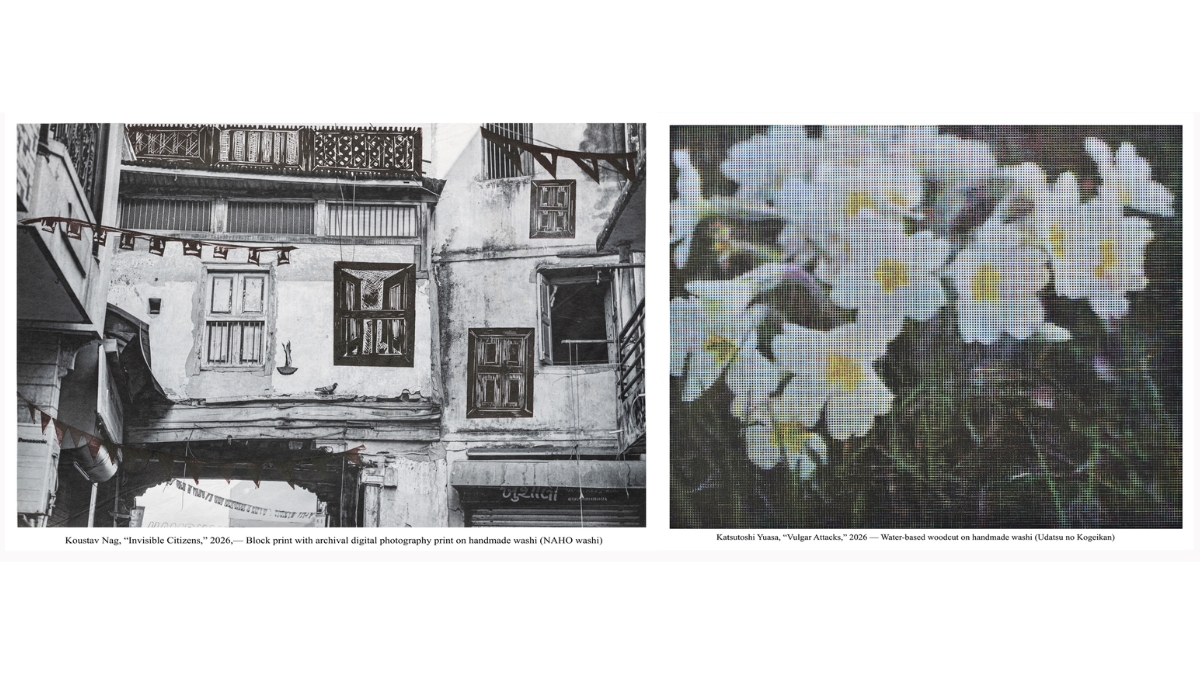
A juxtaposition of continuity and change is evident in two related but distinct methods of handmade Washi art. First, on the left, Invisible Citizens (2026) is a relief print by Koustav Nag that reproduces digital photographs documenting Ahmedabad’s changing urban landscape, printed on NAHO Washi. He uses the techniques of documentary photography and block printmaking to explore displacement, loss of collective memory and the fragile connection between people and the urban environment.
In response, Vulgar Attacks (2026) is a water-based woodcut by Katsutoshi Yuasa, executed on Udatsu no Kogeikan Washi. In his work, Yuasa uses delicate white flowers as symbols of peace and the beauty of nature, but the provocative title calls that first impression into question. Changes in colour, light and texture give the picture an entirely new meaning, highlighting vulnerability, temporality and violence in a person’s everyday life.
Thus, both works demonstrate Washi not only as a material but also as a conceptual means that connects past and present. While Nag is focused on the psychological and sociological aspects of urbanisation, Yuasa focuses on the emotional and sensual aspects of nature. The paper’s spiritual value lies in this dialogue. In Japanese, kami can mean both “paper” and “god”, denoting its important ritual role as well as presence in objects such as Gohei. Echizen holds a special place in this context because of Okamoto-Otaki Shrine, the only shrine in Japan dedicated to the deity of papermaking. Hence, presenting this exhibition in Echizen establishes a dialogue between contemporary artistic practice and living heritage, in which material, craftsmanship, and spirituality are closely interwoven.
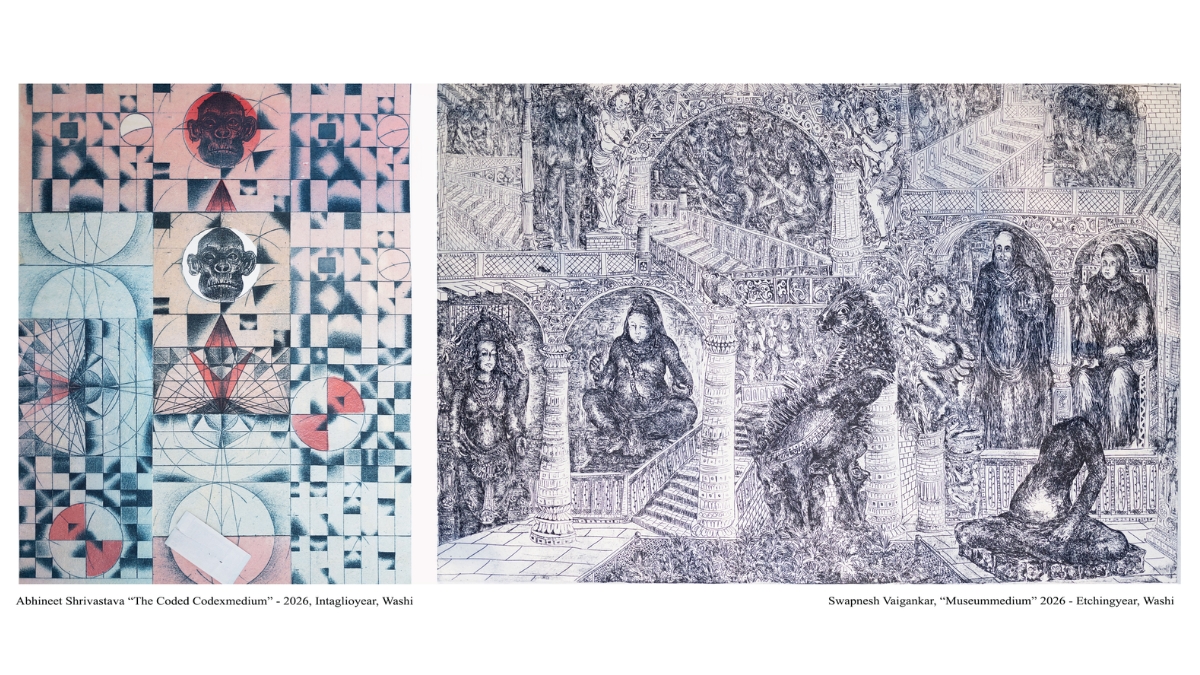
The Coded Codex of Abhineet Shrivastava weaves together symbolic language, history, and contemporary technological imagination. and Swapnesh Vaigankar’s Museum represent two distinct yet interconnected tendencies in contemporary Indian printmaking. Ecstasy is a relief print that explores themes of emotional consciousness and spiritual transformation through bright colours, layered textures, and organic abstraction. Museum is an exquisite etching that creates metaphors of collective memory as architectural interiors in which sculptures, staircases, and layers embody historical and imaginary past. While Ecstasy looks inward at psychological experience, the Museum examines the process of collecting and reinterpreting collective memory. Both are executed on handmade Echizen Washi, thereby creating a dialogue between Indian artistic practice and the Japanese tradition of papermaking.
This exhibition also showcases a wide range of contemporary Indian printmaking through diverse artistic techniques and approaches. The Unseen of Anjali Goel reveals hidden worlds and ecosystems through layered organic shapes combining scientific observation and poetic imagination. Persistence of Angshita Bhattacharya transforms botanical images into a reflection on resilience, regeneration, and the endless cycles of nature. Rubberra Rubber! by Jyothidas K. V. critiques labour, material culture, and industrial landscapes through the linocut technique. Priyanka Batra’s Ecstasy Raja Boro’s Sunset View, Moira River, shows the peaceful atmosphere of the landscape through woodcut, inviting contemplation. Where Instinct Sleeps, by Narendar Singh, explores subconscious motivations and impulses through hybrid forms that blur the boundaries between human, animal, and mythological images. The Arrival of the Great Dickuth of Sagnik Samanta is a constructed mythology, conveyed through fictional characters and narratives, that reflects on issues of belief, power, memory, and humanity’s desire to create meaning.
These artworks together demonstrate the richness of contemporary Indian printmaking. The techniques used include woodcut, linocut, etching, intaglio, plate lithography, and relief printing. The artists raise questions about identity, history, environment, and human existence, adding new dimensions to the value of handmade Echizen Washi by fostering a dialogue between the Japanese tradition of papermaking and Indian printmaking practices.
Venue: Takefu Public Hall Memorial Museum
Dates: 11.07.2026 – 16.08.2026
We want to thank the Centre for the Science of Human Endeavour, the City of Echizen, and all sponsors whose generous contributions helped make this project a reality. We also want to thank JAPAN CULTURAL EXPO 2.0 for their financial support, which made it possible for Koustav Nag and Anjali Goel, founders of Studio Printmaking India, to participate in this exhibition in Echizen. Moreover, we thank papermaking studios that generously provided handmade Echizen Washi, allowing Indian artists to become acquainted with one of the most precious Japanese craft traditions. This exhibition will further strengthen the artistic dialogue between India and Japan, showing that printmaking is not just an exchange of techniques, but a meeting of histories and human experiences.
If you object to the content of this press release, please notify us at [email protected]. We will respond and rectify the situation within 24 hours.